定制ShaderGraph(五)---PBR的核心算法实现
定制ShaderGraph(五)---PBR的核心算法实现
定制ShaderGraph(五)—PBR的核心算法实现
00 前置知识
HDRP去除全部的干扰项才能够看到具体的计算结构.
HDRP默认就启用了大量的后处理和额外的光照系统, 现在我们来一个一个的关掉.
建立一个HDRP的空工程的空场景.
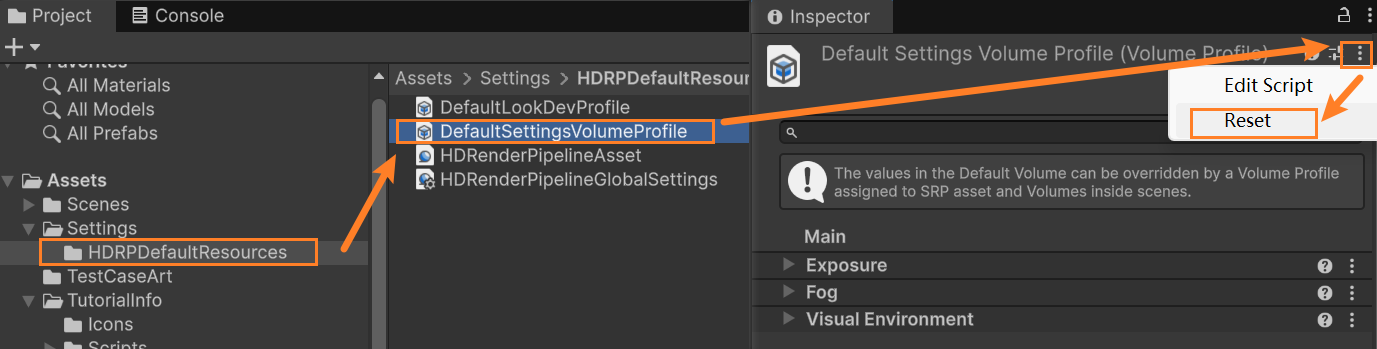
找到你的默认Volume文件, Reset它.
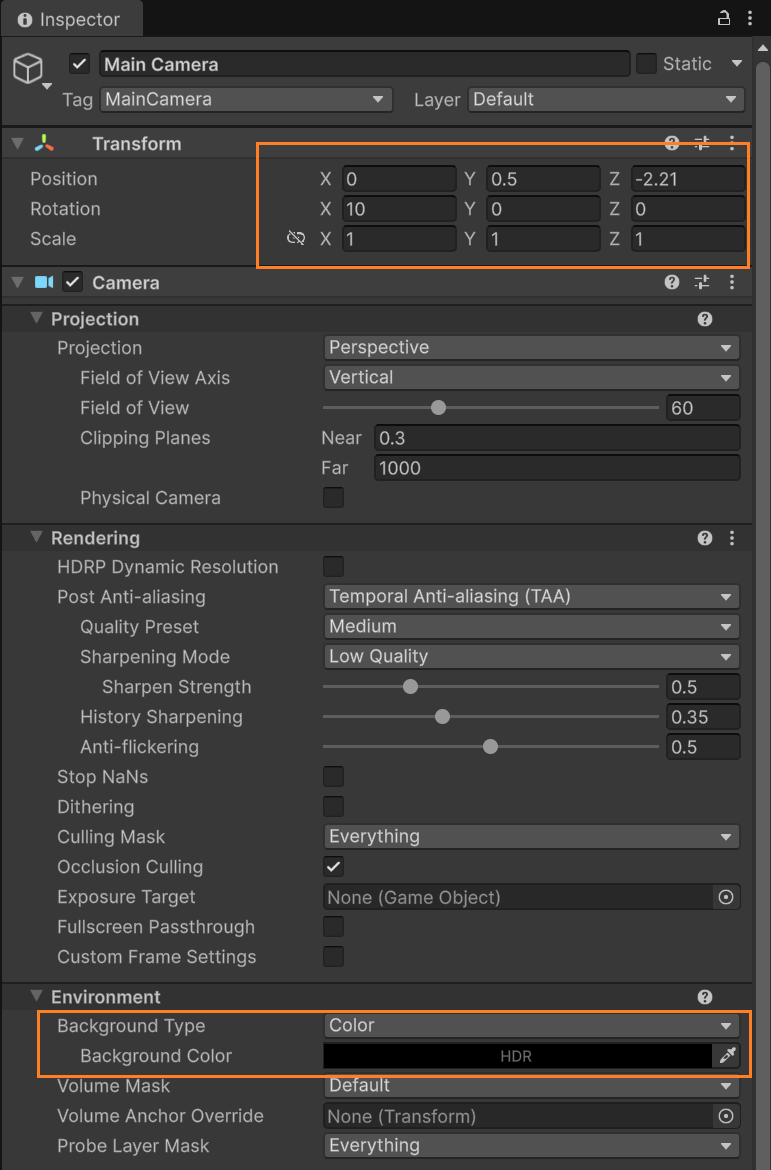
创建一个相机, 参数如下, 只有橙框内的参数才是重要的.
- 角度调整可以根据你的物体的需要改变
- Background Type一定要选Color并且选成黑色, 不然Buffer不刷新
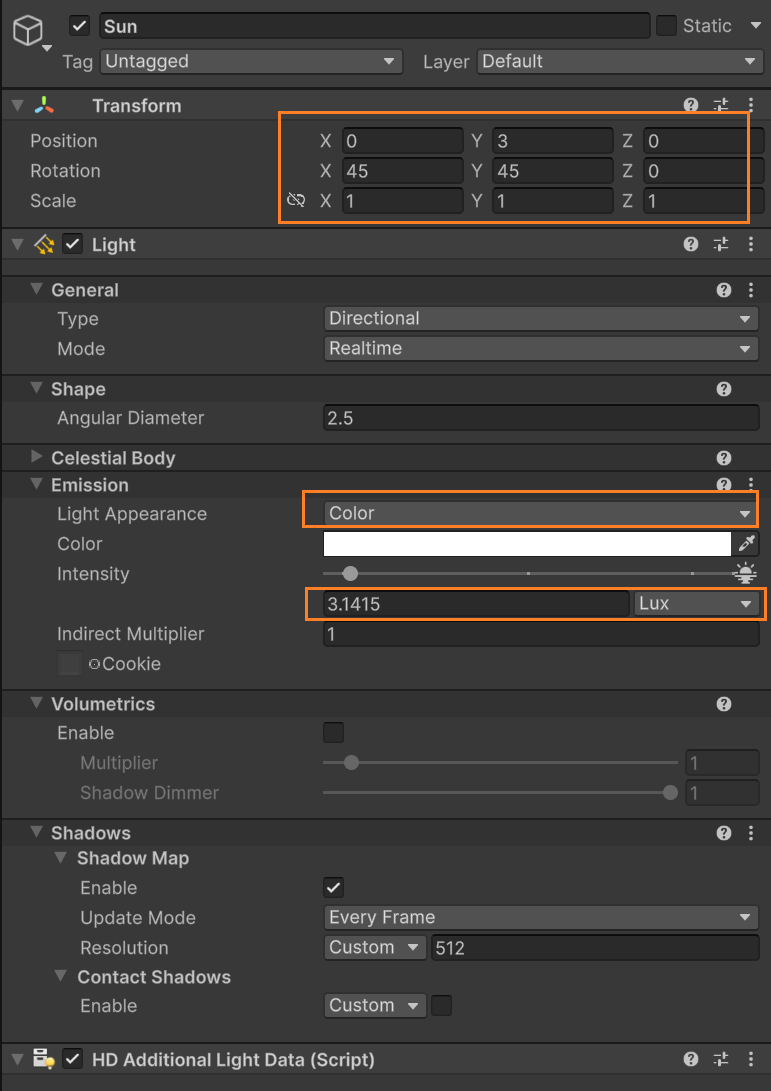
创建一盏灯光, 参数如下
- 角度可以格局你的需要进行调整
- 强度为Pi, 3.1415926535…
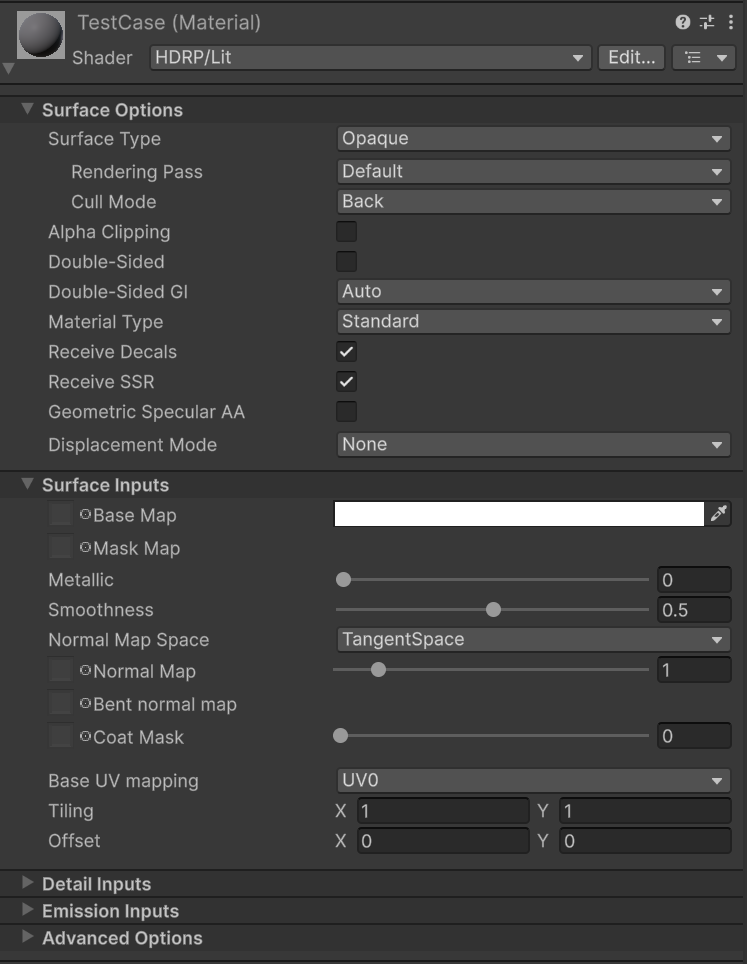
创建一个Sphere对象, 新建材质球, 无需设置, 参数如下
然后你就可以在Game窗口得到最基础的光照模型表现
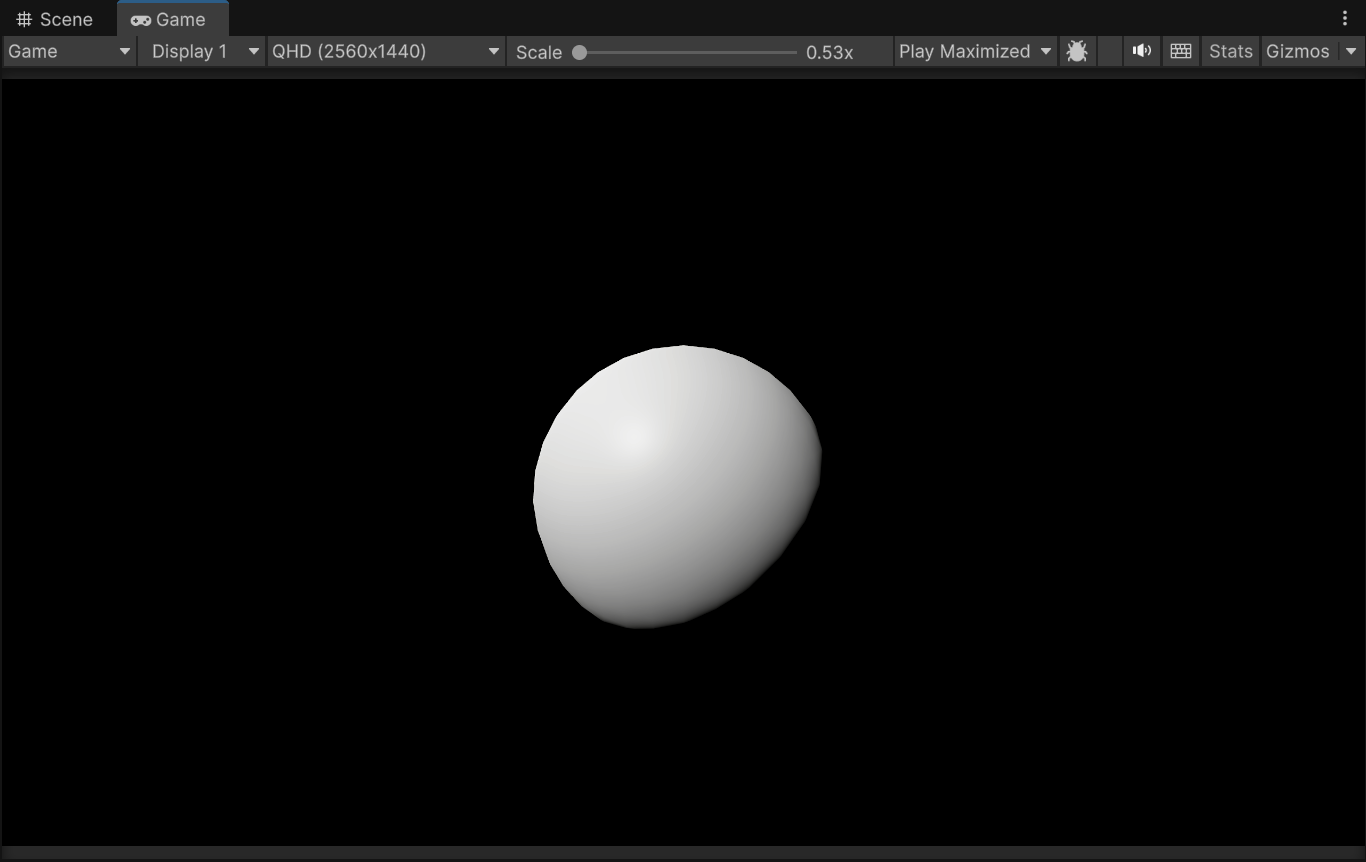
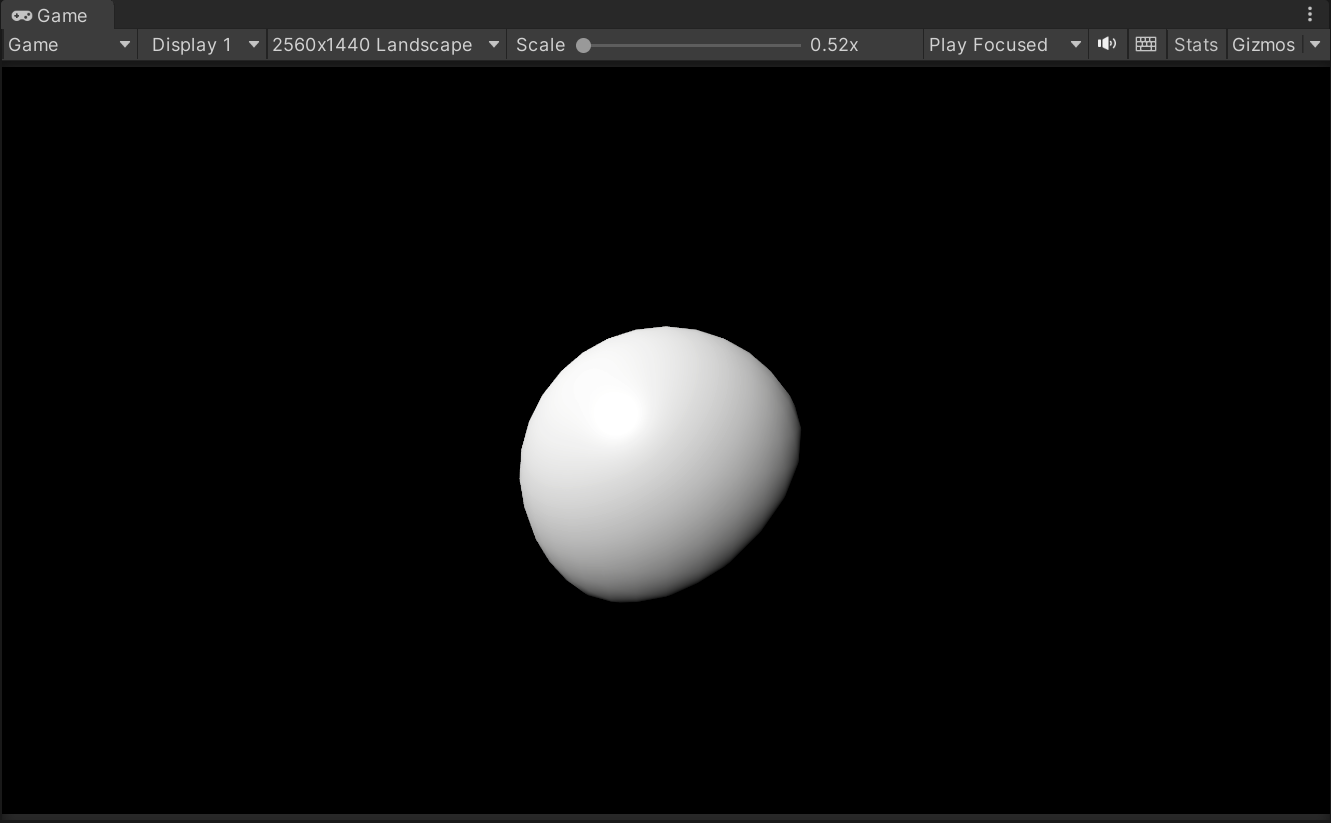
类似的方式, 在URP中, 得到的图像是这样, 整体会比HDRP的要亮一些, 但目前我没有找到原因.
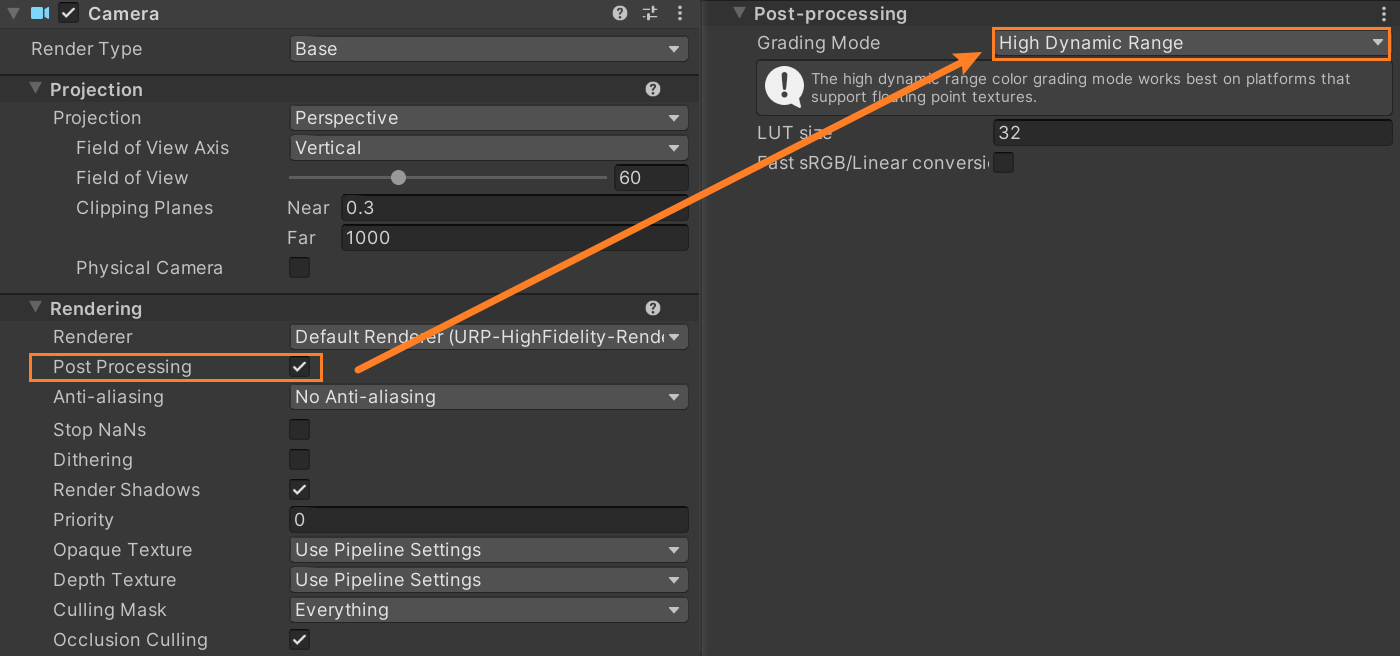
注意: 在URP中, 如果你开启了相机的Post Processing, 那么一定要选择High Dynamic Range, 不然你的黑色会被映射成(13,13,0)的颜色
01 预热
说了那么一大段的前置知识, 仅仅是为了说明, 在(URP中光强度1)=(HDRP中光强度PI).
原因在于HDRP核心算法EvaluateBSDF中, float diffTerm = Lambert();这里的Lambert(), 代码是
1
2
3
4
real Lambert()
{
    return INV_PI;
}
核心代码
HDRP
Library/PackageCache/com.unity.render-pipelines.high-definition@d4732d67dfef/Runtime/Material/Lit/Lit.hlslEvaluateBSDF()
URP
Library/PackageCache/com.unity.render-pipelines.universal@12.1.10/ShaderLibrary/Lighting.hlslLightingPhysicallyBased()
下面开始移植
02 PBR
URP的核心函数
1
2
3
4
5
6
7
8
9
10
11
12
13
14
15
16
17
18
19
20
21
22
23
24
25
26
27
28
29
30
31
32
33
34
35
// Library/PackageCache/com.unity.render-pipelines.universal@12.1.10/ShaderLibrary/Lighting.hlsl
half3 LightingPhysicallyBased(BRDFData brdfData, BRDFData brdfDataClearCoat,
    half3 lightColor, half3 lightDirectionWS, half lightAttenuation,
    half3 normalWS, half3 viewDirectionWS,
    half clearCoatMask, bool specularHighlightsOff)
{
    half NdotL = saturate(dot(normalWS, lightDirectionWS));
    half3 radiance = lightColor * (lightAttenuation * NdotL);

    half3 brdf = brdfData.diffuse;
#ifndef _SPECULARHIGHLIGHTS_OFF
    [branch] if (!specularHighlightsOff)
    {
        brdf += brdfData.specular * DirectBRDFSpecular(brdfData, normalWS, lightDirectionWS, viewDirectionWS);

#if defined(_CLEARCOAT) || defined(_CLEARCOATMAP)
        // Clear coat evaluates the specular a second timw and has some common terms with the base specular.
        // We rely on the compiler to merge these and compute them only once.
        half brdfCoat = kDielectricSpec.r * DirectBRDFSpecular(brdfDataClearCoat, normalWS, lightDirectionWS, viewDirectionWS);

            // Mix clear coat and base layer using khronos glTF recommended formula
            // https://github.com/KhronosGroup/glTF/blob/master/extensions/2.0/Khronos/KHR_materials_clearcoat/README.md
            // Use NoV for direct too instead of LoH as an optimization (NoV is light invariant).
            half NoV = saturate(dot(normalWS, viewDirectionWS));
            // Use slightly simpler fresnelTerm (Pow4 vs Pow5) as a small optimization.
            // It is matching fresnel used in the GI/Env, so should produce a consistent clear coat blend (env vs. direct)
            half coatFresnel = kDielectricSpec.x + kDielectricSpec.a * Pow4(1.0 - NoV);

        brdf = brdf * (1.0 - clearCoatMask * coatFresnel) + brdfCoat * clearCoatMask;
#endif // _CLEARCOAT
    }
#endif // _SPECULARHIGHLIGHTS_OFF

    return brdf * radiance;
}
HDRP的核心函数
1
2
3
4
5
6
7
8
9
10
11
12
13
14
15
16
17
18
19
20
21
22
23
24
25
26
27
28
29
30
31
32
33
34
35
36
37
38
39
40
41
42
43
44
45
46
47
48
49
50
51
52
53
54
55
56
57
58
59
60
61
62
63
64
65
66
67
68
69
70
71
72
73
74
75
76
77
78
79
80
81
82
83
84
85
86
87
88
89
90
91
92
93
94
95
96
97
98
99
100
101
102
103
104
105
106
107
108
109
110
111
112
113
114
115
116
117
118
119
120
121
122
123
124
125
126
127
128
129
130
131
132
133
134
// Library/PackageCache/com.unity.render-pipelines.high-definition@d4732d67dfef/Runtime/Material/Lit/Lit.hlsl
CBSDF EvaluateBSDF(float3 V, float3 L, PreLightData preLightData, BSDFData bsdfData)
{
    CBSDF cbsdf;
    ZERO_INITIALIZE(CBSDF, cbsdf);

    float3 N = bsdfData.normalWS;

    float NdotV = preLightData.NdotV;
    float NdotL = dot(N, L);
    float clampedNdotV = ClampNdotV(NdotV);
    float clampedNdotL = saturate(NdotL);
    float flippedNdotL = ComputeWrappedDiffuseLighting(-NdotL, TRANSMISSION_WRAP_LIGHT);
    float diffuseNdotL = clampedNdotL;

    float LdotV, NdotH, LdotH, invLenLV;
    GetBSDFAngle(V, L, NdotL, NdotV, LdotV, NdotH, LdotH, invLenLV);

    // This F90 term can be used as a way to suppress completely specular when using the specular workflow.
    float3 F = F_Schlick(bsdfData.fresnel0, bsdfData.fresnel90, LdotH);
    // Remark: Fresnel must be use with LdotH angle. But Fresnel for iridescence is expensive to compute at each light.
    // Instead we use the incorrect angle NdotV as an approximation for LdotH for Fresnel evaluation.
    // The Fresnel with iridescence and NDotV angle is precomputed ahead and here we jsut reuse the result.
    // Thus why we shouldn't apply a second time Fresnel on the value if iridescence is enabled.
    if (HasFlag(bsdfData.materialFeatures, MATERIALFEATUREFLAGS_LIT_IRIDESCENCE))
    {
        F = lerp(F, bsdfData.fresnel0, bsdfData.iridescenceMask);
    }

    float DV;
    if (HasFlag(bsdfData.materialFeatures, MATERIALFEATUREFLAGS_LIT_ANISOTROPY))
    {
        float3 H = (L + V) * invLenLV;

        // For anisotropy we must not saturate these values
        float TdotH = dot(bsdfData.tangentWS, H);
        float TdotL = dot(bsdfData.tangentWS, L);
        float BdotH = dot(bsdfData.bitangentWS, H);
        float BdotL = dot(bsdfData.bitangentWS, L);

        // TODO: Do comparison between this correct version and the one from isotropic and see if there is any visual difference
        // We use abs(NdotL) to handle the none case of double sided
        DV = DV_SmithJointGGXAniso(TdotH, BdotH, NdotH, clampedNdotV, TdotL, BdotL, abs(NdotL),
                                   bsdfData.roughnessT, bsdfData.roughnessB, preLightData.partLambdaV);
    }
    else if (HasFlag(bsdfData.materialFeatures, MATERIALFEATUREFLAGS_SSS_DUAL_LOBE))
    {
        // We reload roughnesses from diffusion profile to save VGPRs. As a result we don't have correct ClampRoughness but it's ok
        float lobeA, lobeB, lobeMix;
        GetDualLobeParameters(bsdfData.diffusionProfileIndex, lobeA, lobeB, lobeMix);

        // We have to inline the call to PerceptualRoughnessToPerceptualSmoothness for better codegen
        float roughnessL = PerceptualSmoothnessToRoughness(saturate(lobeA - bsdfData.perceptualRoughness * lobeA));
        float roughnessH = PerceptualSmoothnessToRoughness(saturate(lobeB - bsdfData.perceptualRoughness * lobeB));

        DV = lerp(DV_SmithJointGGX(NdotH, abs(NdotL), clampedNdotV, roughnessL, preLightData.partLambdaV),
                  DV_SmithJointGGX(NdotH, abs(NdotL), clampedNdotV, roughnessH, preLightData.partLambdaV),
                  lobeMix);
    }
    else
    {
        // We use abs(NdotL) to handle the none case of double sided
        DV = DV_SmithJointGGX(NdotH, abs(NdotL), clampedNdotV, bsdfData.roughnessT, preLightData.partLambdaV);
    }

    float3 specTerm = F * DV;

#ifdef USE_DIFFUSE_LAMBERT_BRDF
    float diffTerm = Lambert();
#else
    // A note on subsurface scattering: [SSS-NOTE-TRSM]
    // The correct way to handle SSS is to transmit light inside the surface, perform SSS,
    // and then transmit it outside towards the viewer.
    // Transmit(X) = F_Transm_Schlick(F0, F90, NdotX), where F0 = 0, F90 = 1.
    // Therefore, the diffuse BSDF should be decomposed as follows:
    // f_d = A / Pi * F_Transm_Schlick(0, 1, NdotL) * F_Transm_Schlick(0, 1, NdotV) + f_d_reflection,
    // with F_Transm_Schlick(0, 1, NdotV) applied after the SSS pass.
    // The alternative (artistic) formulation of Disney is to set F90 = 0.5:
    // f_d = A / Pi * F_Transm_Schlick(0, 0.5, NdotL) * F_Transm_Schlick(0, 0.5, NdotV) + f_retro_reflection.
    // That way, darkening at grading angles is reduced to 0.5.
    // In practice, applying F_Transm_Schlick(F0, F90, NdotV) after the SSS pass is expensive,
    // as it forces us to read the normal buffer at the end of the SSS pass.
    // Separating f_retro_reflection also has a small cost (mostly due to energy compensation
    // for multi-bounce GGX), and the visual difference is negligible.
    // Therefore, we choose not to separate diffuse lighting into reflected and transmitted.

    // Use abs NdotL to evaluate diffuse term also for transmission
    // TODO: See with Evgenii about the clampedNdotV here. This is what we use before the refactor
    // but now maybe we want to revisit it for transmission
    float diffTerm = DisneyDiffuse(clampedNdotV, abs(NdotL), LdotV, bsdfData.perceptualRoughness);
#endif

    if (HasFlag(bsdfData.materialFeatures, MATERIALFEATUREFLAGS_LIT_CLEAR_COAT))
    {
        // Apply isotropic GGX for clear coat
        // Note: coat F is scalar as it is a dieletric
        float coatF = F_Schlick(CLEAR_COAT_F0, LdotH) * bsdfData.coatMask;
        // Scale base specular
        specTerm *= Sq(1.0 - coatF);

        // Add top specular
        // TODO: Should we call just D_GGX here ?
        // We use abs(NdotL) to handle the none case of double sided
        float DV = DV_SmithJointGGX(NdotH, abs(NdotL), clampedNdotV, bsdfData.coatRoughness, preLightData.coatPartLambdaV);
        specTerm += coatF * DV;

        // Note: The modification of the base roughness and fresnel0 by the clear coat is already handled in FillMaterialClearCoatData

        // Very coarse attempt at doing energy conservation for the diffuse layer based on NdotL. No science.
        diffTerm *= lerp(1, 1.0 - coatF, bsdfData.coatMask);
    }

    // Diffuse power modification
    if (HasFlag(bsdfData.materialFeatures, MATERIALFEATUREFLAGS_SSS_DIFFUSE_POWER))
    {
        float power = GetDiffusePower(bsdfData.diffusionProfileIndex);
        diffuseNdotL = pow(diffuseNdotL, max(power + 1, 1.0f));
        diffuseNdotL *= power * 0.5 + 1; // normalize
    }

    // The compiler should optimize these. Can revisit later if necessary.
    cbsdf.diffR = diffTerm * diffuseNdotL;
    cbsdf.diffT = diffTerm * flippedNdotL;

    // Probably worth branching here for perf reasons.
    // This branch will be optimized away if there's no transmission.
    if (NdotL > 0)
    {
        cbsdf.specR = specTerm * clampedNdotL;
    }

    // We don't multiply by 'bsdfData.diffuseColor' here. It's done only once in PostEvaluateBSDF().
    return cbsdf;
}
参考网页
参考代码
本文由作者按照 CC BY 4.0 进行授权